


The important job of a head gasket
When your car's cylinder head is bolted to the top of the engine block, a thin, pre-cut template (usually made of steel plus rubber, Teflon or graphite) is placed between the head and block.
This cylinder head gasket is from a 4 cylinder engine.
 This head gasket was leaking coolant in the lower right corner. Electrolysis has eaten away the material from an insufficient antifreeze ratio or too old of antifreeze. A break in the round cylinder area can cause overheating and coolant consumption.
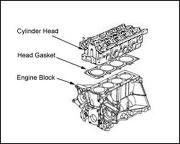
This very sophisticated gasket seals off each of the combustion chambers (cylinders) to prevent any leakage of cylinder combustion or coolant and motor oil that circulate (in separate passages) inside the engine block and cylinder head. A head gasket fails or "blows" when it begins to leak due to cracking, burning, melting or warping. These conditions are often caused by pre-ignition or detonation (pinging), overheating or by improper installation of the gasket or a warped cylinder head or engine block. Electrolysis can also destroy a gasket.
The result of a failed head gasket is usually an internal leak between combustion and coolant areas, but can also be a leak of engine oil. If you catch it early, merely replacing the gasket may solve the problem. But as the leak continues to get worse, bad things can happen to your engine.
Signs of a compression leak through the head gasket could be:
- A sudden loss of engine power
- Engine coolant that's being forced out of the recovery tank or radiator.
- Unexplained coolant loss
- Intermittent or constant engine running too hot or overheating.
- Misfire on cold startup.
- White exhaust smoke on a warm day.
Indications of a bad head gasket can take many forms, such as a misfire on startup especially when the engine is cold, caused by coolant in the cylinder, overheating, white exhaust smoke from a fully warmed up engine-- or sweet smelling steam coming out of your tailpipe and a mysterious loss of coolant, with no visible dripping. Many times you can have a small head gasket leak without any of the above symptoms other than a gradual loss of coolant.
Note: High humidity and colder temperatures can also cause white smoke from the tailpipe which is sometimes misdiagnosed as head gasket failure.
Milky, frothy oil on the dipstick could mean you have coolant leaking into your oil pan, but doesn't necessarily mean a bad head gasket. This symptom is too often mis-diagnosed as a bad head gasket with unneeded repairs performed. There are many other things that can also cause this and it is rarely a headgasket. The majority of head gasket failures do not show this symptom. This usually only happens if coolant collects and sits on the piston and hydro-locking usually occurs first if this is happening.
In fact, most of the time we encounter milky oil it is not a head gasket problem and most of the time when we find a bad head gasket, the oil looks normal.
Much of the cost of replacing a head gasket is for labor, as the engine has to be partially dismantled to get at the gasket. This explains why the cost will vary quite a bit from one vehicle to another.
Unfortunately, some engines are more prone to head gasket failures than others. This is usually due to the design of either the engine or the head gasket.
Overheating due to another cooling system problem and Pre-ignition or detonation are the major causes of head gasket failures between the combustion chamber and the cooling system. Other causes are corrosive (old or rusty) coolant, defective cooling fan or other cooling system defect.
The best way to test for a small head gasket leak is a cylinder leakage test at each cylinder. This is done with compressed air in each cylinder while watching a full cooling system for expansion out the radiator cap inlet.
A compression test will rarely find a head gasket leak unless the leak is so big it is obvious anyway.
Sometimes a leaking intake manifold can mimic a bad head gasket.
Your technician can also test to see if there are any combustion gases present in your radiator, but this test will not always pickup small leaks.
There is always the option of trying a stop leak solution or pellet, but in most cases, trying to seal the leak in this fashion is a waste of time, and adding foreign substances to your cooling system may tend to clog up the radiator and heater core.
There are certain engines that come from the manufacturer with a recommendation to use a specific type of sealant pellet as a part of normal cooling system maintenance to prevent the leaks from starting in the first place. This is to compensate for a slight design flaw in the engine.

_______________________________________________________________________________________________________________________
Serving Eugene, Oregon and Springfield, Oregon's car, truck and SUV auto repair needs since 1973.
Integrity, Quality and Unmatched Service.