


What causes dirty Fuel Injectors?
We often hear about dirty fuel injectors, but what makes them dirty? Most of the time it's not actually from dirt or debris in the fuel, but the fuel itself.
Gasoline contains waxy compounds that can leave varnish deposits at the injector pintle when the fuel evaporates. These deposits tend to form after the engine is shut off. Heat from the engine causes residual fuel in the injector tips to evaporate, leaving a varnish deposit. These deposits in the nozzle build up and restrict fuel flow or disrupt the injector's spray pattern.
On many late-model engines, the shape and direction of the spray pattern is critical for clean combustion and good performance. If the injector nozzle is dirty, the pattern may be distorted or deflected to one side, causing a lean spot in the combustion chamber that can cause misfire, or even pre-ignition or detonation.
It doesn't take much of a restriction in an injector to lean out the fuel mixture. Only an 8% to 10% restriction in a single fuel injector can be enough to upset the air/fuel mixture and cause a misfire.
Because these deposits are right at the pintle opening, the only good way to remove them once they accumulate is using a powerful cleaner that is run through the injector with the injectors isolated from the fuel system using special equipment designed for that purpose.
The fuel injector cleaner you buy from an auto parts place and put in the fuel tank will help keep the deposits from forming but will not usually remove them once they accumulate. The concentration it takes to remove these deposits if put in your fuel tank (at a great expense) would cause your vehicle to run very poorly, probably not start cold and possibly cause damage to your fuel system and catalytic converter.
Some places are selling fuel injection cleaning by running a solution down the intake hoping it will coat the injectors enough to clean them. This may clean the intake system but will rarely clean an injector nozzle. Don't waste money having it done this way.
Gasoline is supposed to contain enough detergent to prevent these deposits from sticking and accumulating in the injectors. But guess what? Not all gasoline is the same.
Some brands contain much lower levels of detergent than others.

The top injector illustrates the spray pattern of a dirty injector versus
the full flow pattern of the lower injector.
.
How do Gasoline Fuel Injectors Work?
A fuel injector is an electronically controlled valve (solenoid) that is supplied with pressurized fuel from the fuel pump. It opens and closes very quickly (many times a second) to control the amount of fuel delivered.
The amount of time an injector is turned on and spraying fuel is measured in milliseconds and the on/off time is called the duty cycle. Duty cycle is measured as a percent, so 50% duty cycle indicates that the injector is held open and held closed for an equal amount of time. When the engine needs more fuel, the time that the injector stays on (its duty cycle) increases so that more fuel can flow into the engine.
When the injector is energized, an electromagnet moves a plunger that opens the valve, allowing the pressurized fuel to squirt out through a very tiny nozzle. The nozzle is designed to atomize the fuel -- to make as fine a mist as possible so that it can burn easily.
The amount of fuel supplied to the engine is determined by the amount of time the fuel injector stays open. This is called the pulse width, and it is controlled by the Engine Control Module.
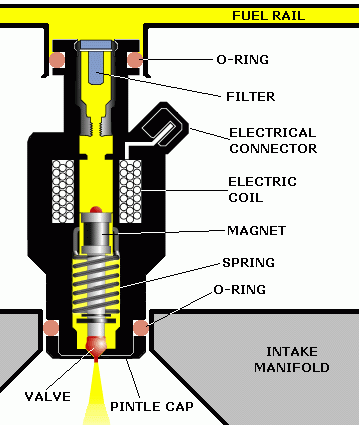
Most Fuel Injected cars use port fuel injection, meaning there is a separate fuel injector for every cylinder.The injectors are inserted in the intake manifold so that they spray fuel directly at the intake valves and are mounted on a "fuel rail" which supplies a precise fuel pressure to each injector.

Rail with 4 port fuel injectors.
Some early Fuel Injection systems used "throttle body injection" which mounted one or two injectors in the throttle body where the carburetor used to be and injected the fuel into the air intake stream. Although more precise and efficient than a carburetor it is not nearly as efficient as Port Injection.